
The fifth week of workshopping was a time to reflect and shift base as needed. We entered the session with feedback from Darinka and Jonathon at AHRC. They had noted the highlights of the sessions and also recommended some ways to provide structure. The theme of structure vs. flexibility based on skills emerged from the session.
In the expansive space of Isabella Center, filled with chairs, tables, and a piano, the participants gathered as Corps Member Chadly and Sakari played saxophone and flute. We sat around the room in a circle listening to Corps Member Marcos begin the session with the usual theater activity, loosening up the group and creating an atmosphere of freedom and collaboration. These opening introduction exercises have been among the highlights of the sessions, with unique and impressive sounds and rhythms coming from the group. In one activity, the group created a “machine” using various rhythmic hand and feet patterns; in another, we “passed a clap” as one person did a variation of a clap (e.g., double clap), and each person imitated the variation or changed it as we went around the circle. The ease and naturalness of such engagement and unification of sound make this kind of exercise an exemplar of the atmosphere we imagine through music.
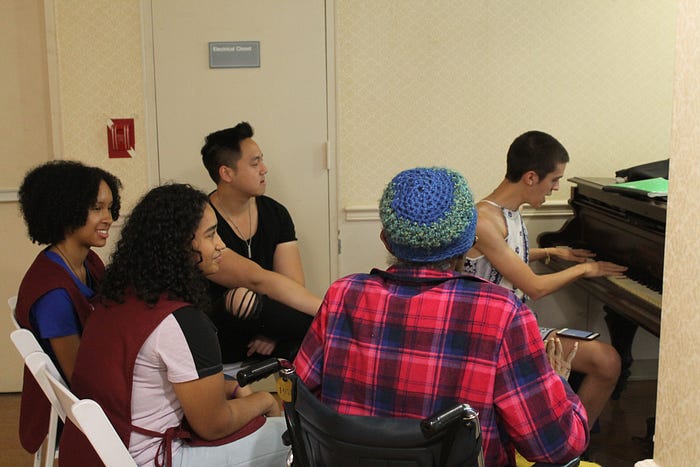
After the opening, everyone broke into their groups with the goal of writing down or planning their songs so that they would be ready to rehearse in the next session. We were in week 5 out of 8, with this session and the next focused on workshopping, week 7 on recording, and week 8 as a song-sharing celebration. We could feel the pressure to have our songs ready in time and were compelled to structure our future sessions more efficiently.
But structure is not always the most conducive to songwriting and music creation. In the case of one of the groups, Zulu P, the members had already extensive experience writing music in an improvisatory manner. During this session, the group wrote down lines of chorus and bridge, and incorporated piano, guitar, and even saxophone. But at the same time, members noted that something was lost when they had tried to structure it too much: there was a loss of learning from AHRC members who knew from their natural skills how to improvise. In a reflection at the end, we discussed how to find a middle ground by having the structured chorus and chords, while maintaining the freedom of freestyling used in Zulu P’s verse.
Another group with Corps Members Sakari and Chadley had a different experience: “We needed structure to direct the group that is used to structured directions from their choir,” they said. During the workshop time, bursts of chorus came from their corner, which Sakari and Chadley attributed to their having had prior time to work on lyrics and guide the group. While walking around the room, it was clear that their approach generated many smiles and engagement as they practiced singing together.
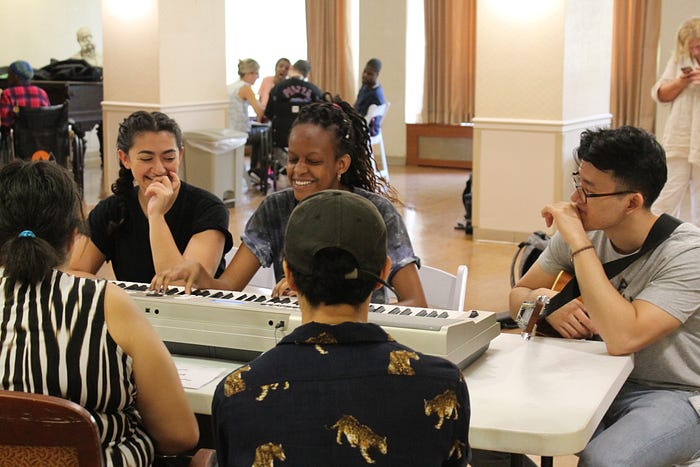
After about 40 minutes of workshopping time, everyone came together to share what they had worked on. One group that was missing a Corps Member and didn’t have all of their materials present and ready became one of the most memorable, because these three AHRC members took the courage to share with the group even though they didn’t have their songs finished, and even though they were the only ones sharing their songs individually. In this group, rather than writing the song among many, each AHRC member was writing a song. Facilitator Paul mentioned on the side, “They are good,” and we both went to the group afterwards to share how impressive we thought their efforts were.
At the end-of-session conversation with the student Corps Members, we reflected on these experiences and discussed the differences between structured and unstructured songwriting processes. We agreed that overall, it has to be a skills-based approach, drawing on and adapting to the wide range of skills, preferences, and workflows of each group. Corps Member Marcos shared after writing his reflection, “I wrote about healing, and I want to keep thinking about what I’ve learned.” We left on this note of mutual learning from everyone’s experiences.
 Humans in Harmony